
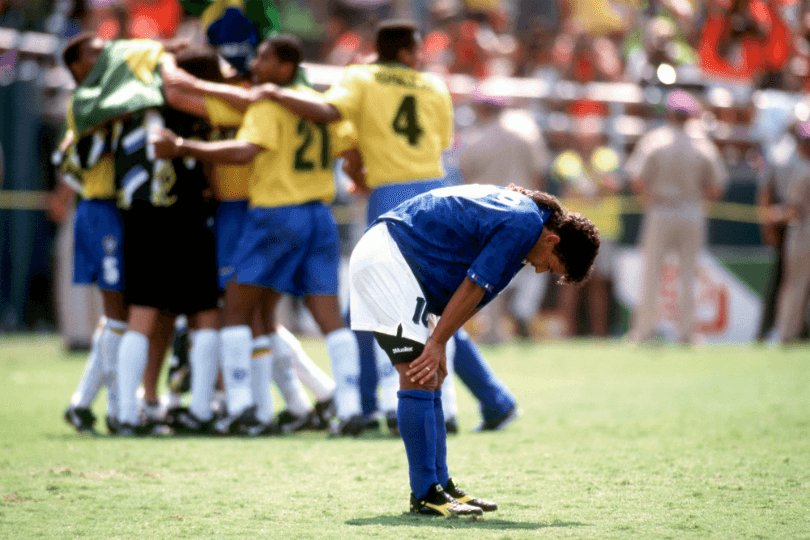
Once again, the Azzurro has vanished from the world’s grandest stage.
In 2018, the suffocating silence of San Siro as the road to Russia slammed shut.
In 2022, the numb tragedy against North Macedonia in Palermo.
And now in 2026, the brutal, unthinkable reality of a third consecutive qualifying catastrophe.
Anyone who holds a love for Italian football is left struck dumb by this recurring nightmare, drowning in disbelief.
Why did that formidable Italy—the indomitable side once revered and feared across the globe—wither and die?
In truth, the precise anatomy of this decay was foretold with piercing accuracy fifteen years ago by one extraordinary man.
Did you know that Roberto Baggio left behind a monumental, 900-page manifesto for the resurrection of Italian football?
It was a 900-page testament, drafted with anguish and devotion by Il Divin Codino himself.
Break the seals on that document today, and you will find every answer modern Italy chose to ignore, etched across its pages.
1. Why Baggio Penned a 900-Page Manifesto
Roberto Baggio.
The very soul of Calcio, and the eternal symbol of the fantasista.
No figure has ever embodied the light and shadow of Italy with such poignant grace.
In 2010, reeling from Italy's humiliating group-stage exit at the South Africa World Cup, Baggio was appointed technical director of the Italian Football Federation (FIGC).
He refused to treat the position as an empty honorific.
For an entire year, Baggio traveled the length and breadth of the country, visiting youth academies and grassroots pitches with his own boots on the ground.
What he witnessed broke his heart: young boys having their natural brilliance stripped away, shackled by clinical efficiency, spreadsheets, and adult tactical dogma.
"I want to save Italian football."
With that solitary, burning resolve, Baggio collaborated with over fifty specialists to compile a staggering 900-page dossier.
Yet the federation met the symbol’s voice with deafening silence.
Terrified by the financial commitment and organizational upheaval required, FIGC executives simply looked the other way.
My 900-page project was completely ignored.
I do not like sitting in a chair doing nothing.
There was no room for my soul in meetings that were purely cosmetic.
In 2013, disillusioned and heartbroken, Baggio walked away.
Italy chose fleeting fashion over the romance Baggio championed.
The price for that cowardice is the purgatory confronting them today: three consecutive World Cups watched from home.
2. The Four Pillars of the Hero’s Blueprint: A Roadmap for Italy's Revival
What Baggio sought to convey across those 900 pages was distilled into four non-negotiable pillars designed to restore the Azzurri’s true greatness.
Pillar 1: Cherish Technique (Tecnica) Over Raw Physicality
At the apex of his manifesto, Baggio demanded a return to Italian aesthetic purity.

He fiercely opposed the creeping tendency to select young players solely on physical metrics—speed, height, brute force.
First and foremost, cultivate an environment that protects and nurtures pure technical ability (Tecnica).
Physical growth will always arrive in its own time; a stunted technical sensitivity, once lost, never returns.
By prioritizing robotic athleticism over technique, Italian football systematically drained the magic from its boots.
Pillar 2: Do Not Cage Children in Tactics—Protect Individuality
Alongside technique, Baggio demanded freedom—the essential soil in which talent breathes.

He condemned the practice of drilling young children into rigid, win-at-all-costs tactical systems.
Forcing young minds into tactical straitjackets designed for adult expediency snuffs out the spark of the fantasista in its cradle.
Rather than breeding obedient cogs for a machine, Italian coaches had to nurture bold individualists who solve problems through intuition.
Coaches, Baggio insisted, must teach courage in trusting one's own instincts, not chalk-talk formations.
Pillar 3: Uphold Moral Ethics (Etica) and the Spirit of Defense
While advocating for creative liberation, Baggio took an equally sharp scalpel to the root of Italy’s proudest tradition: defending.
Before technical prowess on the pitch, instill human responsibility and ethics (Etica).
True Italian defending—the historic soul of Catenaccio—was never merely a clever positional grid.
It was the collective manifestation of an unyielding refusal to lose a individual duel.
Self-discipline, sacrifice, and the deep moral responsibility to defend for one's brothers forge an unbreakable psychological core when everything is on the line.
Pillar 4: Build a Nationwide Scouting Web to Never Lose a Hidden Talent
Finally, Baggio outlined the structural infrastructure required to carry these tenets across the nation.
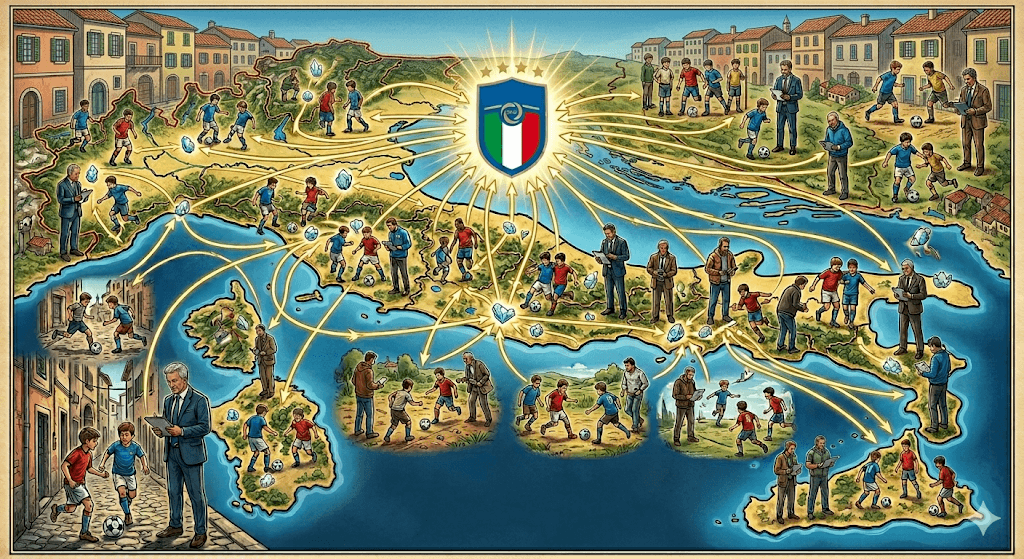
He proposed dividing Italy into 100 dedicated scouting zones, weaving a dense, attentive network.
Genius does not reside exclusively within the pristine walls of metropolitan elite academies.
In provincial clubs and sun-baked alleyways lurk the eccentric mavericks who do not fit neat institutional molds.
A national scouting web to unearth every unpolished diamond and shelter them under a federative umbrella—that was the lifeline to producing tomorrow's Baggio.
3. A Fierce Mentality and the Unleashing of Individual Genius: The Essence of Italy
Weave these four pillars together, and you arrive at the ultimate synthesis:
Unyielding defense born of ethical, relentless steel.
Scintillating attack powered by untamed individual flair.
And an infrastructure that ensures no spark of brilliance slips through the cracks.
That golden balance was the true alchemy that once made the Azzurri terrorize the globe.
When we look at the modern Italian national team, what is the hollow feeling that gnaws at us?
Forwards who can only function inside pre-programmed systems.
Defenders who have lost the art of the duel, relying entirely on fragile zonal coordinates.
It is, note for note, the exact crisis Baggio diagnosed fifteen years ago.
Italy’s greatest idol handed them the keys to avert disaster, and the country dismissed him.
That tragedy carries a weight of profound melancholy.
"The hero foresaw everything and sought to save them, yet his people turned him away."
The price paid for discarding his wisdom in pursuit of shallow modernity has been catastrophic.
Three consecutive World Cups missed: rock bottom cannot sink any lower.
Now is the time for Italy to retrieve that 900-page dossier from the back of the drawer.
Baggio’s words have not aged a day in fifteen years.
Put technique first. Cherish individual rebellion. Forge an uncompromising ethical resolve.
When Italian football finally returns to the romantic heartland its greatest son mapped out—when it blows the dust off those heavy pages and turns the hero's prophecy into living reality—the true resurrection of the Azzurri will begin.



CommentsComing soon
As someone who shares the story, we'd love to hear your words.