Why Hidetoshi Nakata Walked Away at 29: The Aesthetic Rebel Who Chose Beauty Over Modern Football
Hidetoshi Nakata remains the singular, incandescent legend of Japanese football.
The defining face of the 2002 World Cup, he abruptly terminated his professional career at just 29 years old—standing at what appeared to be the radiant zenith of his playing days.
Having conquered Serie A and graced the Premier League as a global cultural icon, what drove him to make such an incomprehensible, resolute exit?
“I’m not a fan of football. I just like playing it.”
With these startling words,
Nakata laid bare his soul in an extraordinary longform interview with The Athletic.
- “I'm not a football fan”: The candid admission that severed him from the commercial spectacle.
- The Shocking Retirement at 29: Walking away at his absolute peak because the pure spark of passion had vanished.
- A Childhood Dream Born in Manga: How Captain Tsubasa ignited his ambition to kick a ball professionally.
- Triumph on Italian Soil: Conquering the Scudetto with AS Roma alongside Francesco Totti.
- A Philosophy of Elegance: Prioritizing spatial poetry, vision, and aesthetic grace over raw physicality and athletic power.
- A Second Life in Artistry: Wandering the earth before falling deeply in love with traditional sake craft, founding his own artisan label.
- An Uncompromising Path: Defying the weight of institutional expectations to live solely by his own aesthetic compass.
Though written in English,
it is an interview every football romantic should experience first-hand,
even with the aid of translation.
One hesitates to summarize it casually,
for in reckless translation, the fragile sincerity and philosophical depth of his thoughts risk slipping away.
Read the full text with your own eyes.
Yet before doing so, let us recall the majestic stature of the player who was Hidetoshi Nakata.
The Phenomenon of Hidetoshi Nakata

To speak of Nakata is to speak of an artist who sat naturally at football’s highest table.
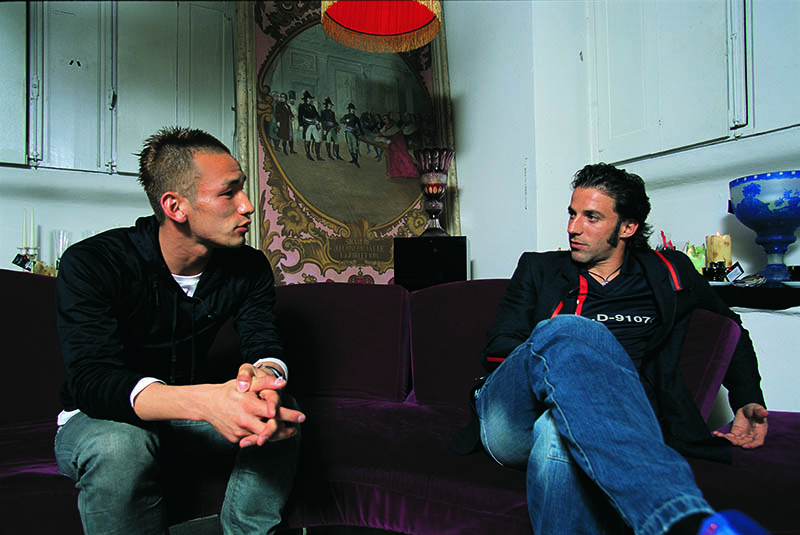
As this archival photograph proves,
he was called upon as a peer by the game’s absolute sovereigns—
Ronaldinho,
Zinedine Zidane—

Standing shoulder to shoulder within this constellation of gods,
Nakata dictated play without an ounce of hesitation: Japan’s greatest footballing masterpiece.
Today, the extraordinary exploits of Wataru Endo, Kaoru Mitoma, and Takefusa Kubo in Europe
bring tears of joy to our eyes.
Yet when pressed: “Have they surpassed Nakata?”
One can only pause, acknowledging how impossibly high he set the bar.
To recount his trajectory is almost superfluous, yet its monumental landmarks demand reverence:
- Instant International Prominence: Selected for the senior national team at just 20 in 1997, blossoming instantly into an indispensable general.
- First Japanese Player to Lift the Scudetto: Guiding AS Roma to the Serie A title in 2000-01, reaching the summit of the world's most defensive league.
- The Engine of the 2002 World Cup: The tactical heartbeat of co-hosts Japan, carrying the Samurai Blue into the knockout stages for the first time in history.
- Pioneering Across European Nobility: Illuminating Italy with Perugia (1998–2000), Roma (2000–2001), Parma (2001–2004), Bologna (2004), Fiorentina (2005), and concluding his European odyssey in England with Bolton Wanderers (2005–2006).
- Unyielding Professionalism: Tireless personal conditioning, fluent linguistic assimilation, and a relentless quest for intellectual excellence.
What defines true greatness is forever subjective,
yet when measured through the prism of his friendships with football royalty,
his transcendent standing is beyond dispute.
Zinedine Zidane (France)
“You made us lose the Scudetto!” (Laughs)
José Mourinho (Portugal)
Perhaps the only Japanese football figure who could ever converse with Mourinho eye-to-eye on the deep metaphysics of the game.
Luís Figo (Portugal)
“Japanese players need only aim to become like [Hidetoshi Nakata].”
Francesco Totti (Italy)
This dialogue was an editorial masterstroke by DAZN.
Whatever frustrations one might hold about subscription fees evaporated in the presence of such historic storytelling.

Forgive the Digression
To understand the inner truth of his playing days
and the genuine core of his farewell,
one must read the original feature published by The Athletic.
One almost wonders if we should request permission to translate the entire masterpiece into Japanese.
For it seems a minor tragedy that an intimate chronicle of Japan’s greatest football son remains behind a foreign paywall.


Share this story