
PHILOSOPHY
Pivote, Anchor, Regista: Three Tactical Ideas at the Base of Midfield
In Japan the word "volante" is shorthand for a defensive midfielder. It comes from Portuguese, where it means "steering wheel," and it took root in Brazil before traveling east. Yet beneath that single label sit three roles with entirely different origins and philosophies: the Spanish-speaking world's pivote, the English anchor, and the Italian regista, the "director."
On the pitch they stand in almost the same place, just behind the centre circle. What differs is what each of them thinks the moment the ball arrives, what they discard and what they choose. One keeps order, one holds the line, one writes the story. The base of midfield is where three ideas about football quietly collide.
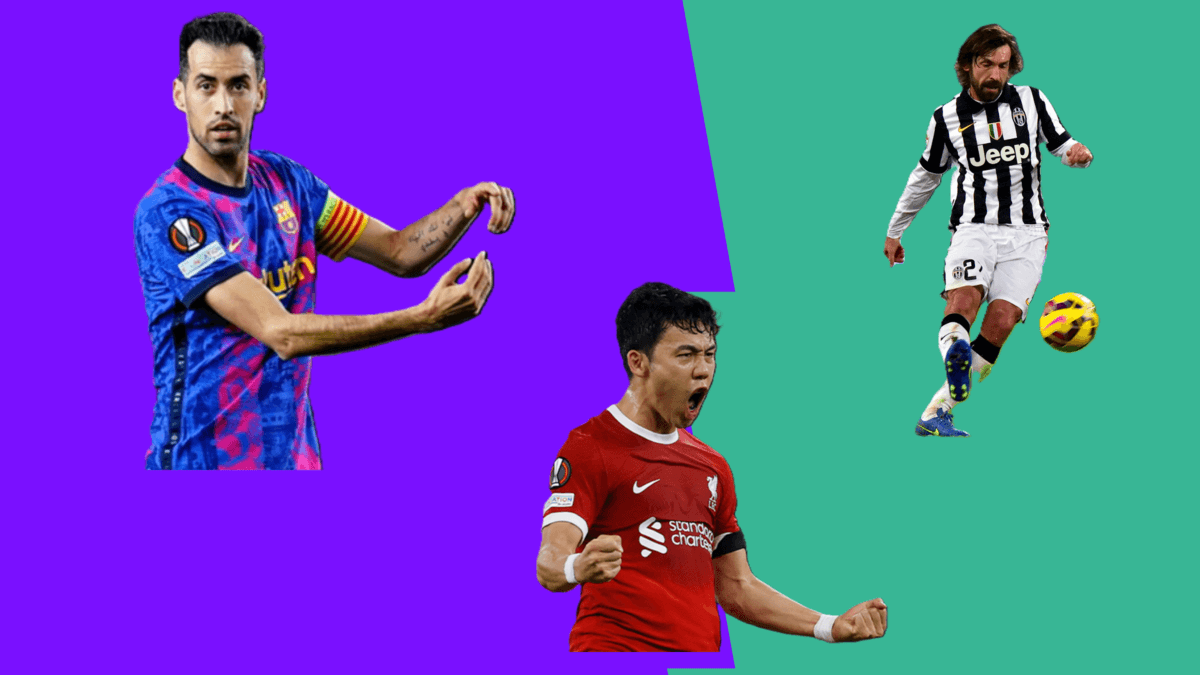
Following three masters, Busquets, Makélélé and Pirlo, this piece traces how each role came to exist and how it changed shape through tactical history.
The Axis That Turns the Game: The Pivote
The name is said to come from the basketball pivot: planting one foot and turning the body around it. In Spain the role took shape in Johan Cruyff's Barcelona "Dream Team," where a young Josep Guardiola stood between defence and attack, circulating the ball left and right, backward and forward. The pivote decides where a team's centre of gravity sits.

The lineage peaks with Sergio Busquets. Promoted from Barcelona's academy by Guardiola, he held the base of midfield for fifteen years. Distance covered and tackles made cannot measure his value. Busquets turns his head before the ball arrives, memorising where teammates and opponents stand. A single turn peels away one line of pressure and gives his side time and space. Without the ball, his positioning alone closes passing lanes and ends danger before it starts.
The pivote also drops between the centre-backs as a third defender and starts the build-up from there. The pattern is called the "salida Lavolpiana," after the Argentine coach Ricardo La Volpe. It refuses to separate defence from attack and treats them as one flow. That is the core of the pivote's philosophy.
When Spain won their first World Cup in 2010, Busquets and Xabi Alonso sat together at the base of midfield and the team conceded only two goals in the whole tournament. If you keep the ball, the opponent never gets to attack. By placing defence and possession on the same line, the pivote was lifted from "defensive midfielder" to architect of the system.
Today Rodri of Manchester City carries the tradition. Winner of the 2024 Ballon d'Or, he too earns wins not through spectacle but by keeping the match in balance. Fabinho, in his Liverpool years, was another pivote who absorbed every transition on one planted foot.
The Immovable Pillar: The Anchor
An anchor holds a ship against the current. The player who bears the name stands in front of the back line and stops attacks. Passing and creativity come second. What counts is a nose for danger, the stamina to cover wide spaces, and strength in one-on-ones.

The man who made the role known to the world was Claude Makélélé. In 2003 he left Real Madrid for Chelsea and was placed at the base of José Mourinho's 4-3-3. In 2004-05, Chelsea won the Premier League conceding just 15 goals, their first title in half a century. His name became a term in English-speaking football: the "Makélélé role." It is a rare case of a player's name becoming the name of a position.
Behind the stars he worked in silence, blocking passing lanes, collecting loose balls, handing the ball to teammates. Spectators barely notice it, but a team without him loses its balance at once. Real Madrid's drift after he left proved the weight of the anchor's role in reverse.
In the old days a 4-4-2 split the base of midfield between two players. When the 4-3-3 spread, a single man in front of the defence became possible. One man to fill the space, one man to stop the attack: the load on the anchor grew accordingly. That is why wide coverage and a calm that never misjudges a moment became essential in that position.
Italy had another kind of anchor in Gennaro Gattuso. At Milan and for the national team he ran, won the ball and crushed duels beside Pirlo. The genius was free because a partner was covered in mud next to him.
Casemiro, who underpinned Real Madrid's golden era, and Declan Rice, a commanding presence at Arsenal, belong to the same line. With strength in duels and an instinct for danger, they remain their teams' "last shield."
The Director Who Writes the Match: The Regista
"Regista" is Italian for director. From the base of midfield he writes the script and gives his team a plot. Defensive power is optional. What matters is the precise long pass, the through ball, and a field of vision wide enough that a single pass changes the look of a match.

The symbol of the role is Andrea Pirlo. Originally an attacking midfielder, he dropped to the base of midfield at Brescia under Carlo Mazzone and was perfected by Carlo Ancelotti at Milan. Without running, without contesting, in the quietest bearing on the pitch, he ruled matches. At the 2006 World Cup, deep in extra time of the semi-final against Germany, his corner led to Grosso's decisive goal. At Euro 2012, he chipped a Panenka in the shoot-out against England. Playfulness beneath the calm was part of his style.
When he joined Juventus at 32, Antonio Conte's 3-5-2 shielded him from defensive burden, and he became the starting point of four straight titles. The gaps in defence are filled by others, and in return he delivers the ball from anywhere on the pitch. The regista is a luxury role made possible by the whole system.
Watch Pirlo again and you notice that most of his work happens in the seconds before he receives. He senses where the press will come from, turns half a step, opens a passing lane, and sends the ball to a place where nobody has started running yet. The receiver need only move in time. That is why they call him a director.
Jorginho, and Toni Kroos, who retired in 2024, follow in this line. Kroos was a hybrid who could also run in defence, but his ability to set the tempo the moment he held the ball was pure regista.
Where the Three Ideas Meet Today
Set the three roles side by side once more.
| Type | Origin | Defence | Distribution | Control of the game | Coverage | Creativity | Emblem |
|---|---|---|---|---|---|---|---|
| Pivote | Spanish (axis) | ◎ | ◎ | ○ | ◎ | △ | Busquets |
| Anchor | English (anchor) | ◎ | △ | △ | ◎ | × | Makélélé |
| Regista | Italian (director) | △ | ◎◎ | ◎ | △ | ◎◎ | Pirlo |
◎ = excels, ○ = competent, △ = weak, × = almost none.
On the pitch the three roles are not always sharply separated. In an age of constant pressing, nobody can stand at the base of midfield without technique at the feet, and a regista who cannot defend cannot function. Players like Busquets blend defence and distribution, and even anchors are now asked to contribute to build-up.
Still, the three ideas have not vanished. Keep order, hold the line, or write the story: a coach chooses what to place at the base of midfield according to what the team needs. Follow where the ball starts to move in the next match, and the idea behind that choice will come into view.
Popular this week
7 DAYS
01選手物語
The Japanese Philosophy Quietly Anchoring Michael Olise’s Genius
02フットボール文化
The Dream Seven Men Chased in a Parisian Alley: How FIFA Became the "Universal Language of the Earth"
03フットボール文化
Fierce Rivals Under One Sacred Roof: The Secrets of San Siro and Milan’s Shared Cathedral
04legend
The Endangered Soul: Football's "One-Club Men" and the Lost Romance of Undying Loyalty
Share this story


CommentsComing soon
As someone who shares the story, we'd love to hear your words.