

PHILOSOPHY
The Evolution of the Number Ten: From Trequartista to False Nine

In football the "number ten" spot has long been special. Between forwards and midfield, lurking in the most dangerous part of the opponent's half, it is the freest position and the one that demands the most creativity. The players who stood there were the heart of the attack, artists and magicians. Many who wore the number ten left plays burned into the memory of the crowd.
But football never stops evolving. As defences became organised and high pressing spread, the "ten who does not defend" lost his place and the role gradually changed shape. Is the number ten dead? Or has it survived under other names?
Through three forms, the trequartista, the second striker and the false nine, this piece traces how one position transformed through tactical history.
The Artist Lurking at Three Quarters: The Trequartista
Trequartista is Italian for "three-quarters." Divide the pitch lengthwise into four from one goal to the other: the player stands three quarters of the way up, between midfield and attack. With little defensive burden he roams freely and creates chances with decisive through balls, final passes and refined technique. He is the prototype of the number ten.
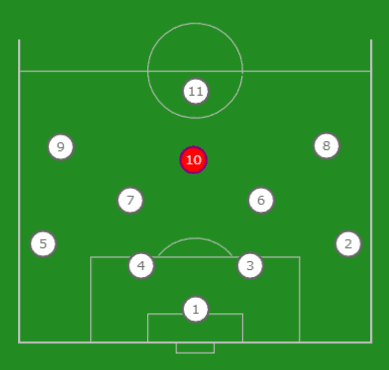
The summit of this line is Roberto Baggio. Moving through Fiorentina, Juventus and Milan, he left a trail of curves as he beat opponent after opponent, still vivid in many memories. Portugal's Rui Costa froze time with his gaze every time he received the ball and offered the final touch at both Fiorentina and Milan. And Brazil's Kaká tore through opposing territory at speed for Milan, winning the Ballon d'Or in 2007.
The value of a trequartista rarely shows up in numbers. It lies in whether he can deliver a pass nobody expects at a moment nobody expects. The flow of the match was entrusted to that single touch. The crowd, too, watched in suspense whenever a number ten took the ball. As he lifted his head and caught a teammate in his line of sight, those silent seconds ruled the stadium's air.
Then the zonal pressing built by Arrigo Sacchi's Milan put a new question to this kind of player. One man who does not defend is enough to break a whole team's organisation. The ten was no longer a privileged seat exempt from defending.
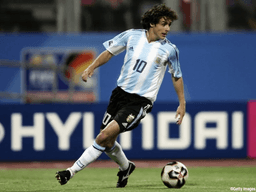
Even so, the pure number ten did not vanish completely. Argentina in the 2000s produced many "enganches" (link men) in this position, setting the tempo through technique and vision and moving everyone around them. The moment the ball came to their feet, the team calmed. Freed from defending, they carried the full responsibility in attack. That was the bargain of the role.
The Second Forward Who Moved Closer to Goal: The Second Striker
As defensive demands grew, the ten moved closer to the forwards and divided into the "second striker." Standing between the number ten and the centre-forward, closer to goal, he works nearer to the scoring zone. Finishing power, combination play with the striker and sharpness in running behind came to matter as much as creativity: distance to goal took priority.
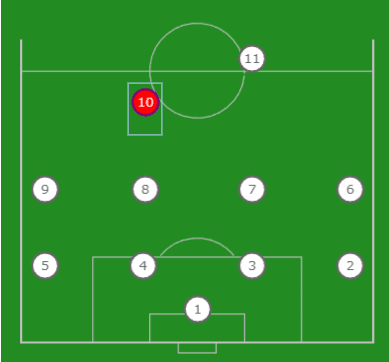
Juventus's Del Piero shone in this role for years. Standing behind tall strikers such as Inzaghi and Trezeguet, he received, ran at defenders and scored himself. Paulo Dybala stood in the same position for Juventus and earned the nickname "La Joya" (the Jewel). The moment he received the ball he turned to face forward and slid through opponents with his small frame. Sergio Agüero, another small man who attacked back lines, belongs to the lineage of the second forward.
The second striker was a realistic evolution that combined the trequartista's creativity with the forward's finishing. The man behind the front man also scores. The change also marked the ten's shift from "director" to "scorer."
The background was the rising height and density of defensive blocks. If the opponent packs the penalty area, the ten has less time and space on the ball. So players who stood near the front from the start and aimed at both goals and final passes became valuable. Creativity had not vanished; it had shortened its distance to goal.
The Spirit of the Ten in the Front Line: The False Nine
The false nine stands in the central striker's spot but drops freely into midfield to receive the ball, drags opposing centre-backs after him and opens a void in the back line. Teammates attack that space. It is a paradoxical position: not one built to score, but one built to produce scoring.
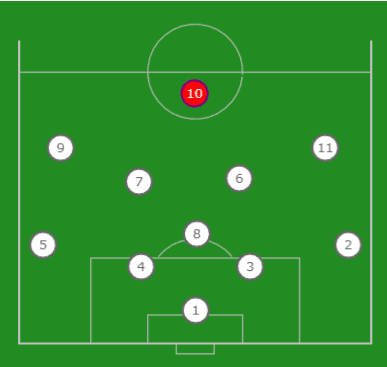
The idea is in fact old. In 1953, when Hungary beat England 6-3 at Wembley, Nándor Hidegkuti confused England's defence with the same kind of movement. Its most vivid modern revival came in May 2009, when Guardiola's Barcelona beat Real Madrid 6-2 at the Santiago Bernabéu. The man in the middle was Lionel Messi.
Messi dropped into midfield, and in the instant the centre-backs hesitated over whether to follow, wingers and midfielders ran in together. Roma's Totti played the same role under Spalletti, puzzling opponents with a lineup without a centre-forward. Liverpool's Roberto Firmino served as the starting point of Jürgen Klopp's high press, combining defending with passing play up front.
The false nine is the spirit of the number ten living in the front line. He touches the ball, passes, makes others run. The work once done by the ten is now taken on by a player wearing nine.
What draws a viewer to the false nine today is the artistry that lives in it. A centre-forward who does not score takes control of the match. That paradox proves the beauty of football.
Is the Number Ten Dead, and Will It Rise Again?

| Era | Main form | Features |
|---|---|---|
| Before the 1990s | Trequartista | Creativity and freedom, craftsman of the final pass |
| 2000s | Second striker | A forward-type ten who also aims for goal |
| 2010s onward | False nine | A "vanishing centre-forward" who builds from the front |
In 2006, Villarreal's Juan Román Riquelme had a late penalty saved in the Champions League semi-final against Arsenal and missed out on the final. It is sometimes called the last flicker of the pure number ten. In modern, organised tactics, players who do not defend lost their place, and the role dispersed and mutated.
But it was not extinction. The false nine, the second striker, the inside half: the spirit of the ten has kept going in new roles. At Real Madrid in 2023-24, Jude Bellingham scored heavily from close to the number ten spot, showing new possibilities for an old position. He defends, and in attack he arrives in the final phase: a modern version unlike the old ten.
Tactics evolve in cycles. Just as the libero, once near extinction, resurfaced in different form at some clubs, a time when number-ten-like players shine again is entirely possible. A moment when individual skill goes beyond tactics: as long as we believe in that beauty, the flame of the ten will not go out. The next to light it may be someone whose name is not yet known. When that happens, the crowd will once more recall what the number ten meant.
Popular this week
7 DAYS
01選手物語
The Japanese Philosophy Quietly Anchoring Michael Olise’s Genius
02フットボール文化
The Dream Seven Men Chased in a Parisian Alley: How FIFA Became the "Universal Language of the Earth"
03フットボール文化
Fierce Rivals Under One Sacred Roof: The Secrets of San Siro and Milan’s Shared Cathedral
04legend
The Endangered Soul: Football's "One-Club Men" and the Lost Romance of Undying Loyalty
Share this story


CommentsComing soon
As someone who shares the story, we'd love to hear your words.