

PHILOSOPHY
Inside Half vs Mezzala: The Ever-Changing Role on the Flanks of Midfield

How the players on the flanks of midfield move greatly affects the flow of a match. Attacking the central space, using the sides and governing transitions, they shape both a team's attacking and defensive strength. In the era of four-man midfields there was a separate role, the wide midfielder; only when the 4-3-3 with three midfielders spread did the "flank" of midfield become a territory of its own.
Two lineages occupy that territory: the "mezzala," nurtured in Italy, and the "inside half," the star of modern football. Their positions look similar, but the roles they contain and the tactical philosophy behind them are entirely different.
Through Marchisio, De Bruyne, Bernardo Silva and others, this piece describes the difference between the two roles and the tactical changes behind them.
The Craftsman of Half a Wing: The Mezzala
Mezzala is Italian for "half-wing." Standing between the centre and the flank, it can show up in either place. Usually deployed on either side of a midfield three in a 4-3-3, it drifts wide to draw the ball and adds thickness to the attack. Sometimes it bursts from the third line into the space behind the opponent's defence or into the penalty area. Rather than waiting outside the defensive block, it walks into the gaps of the block itself: that was the role's signature.
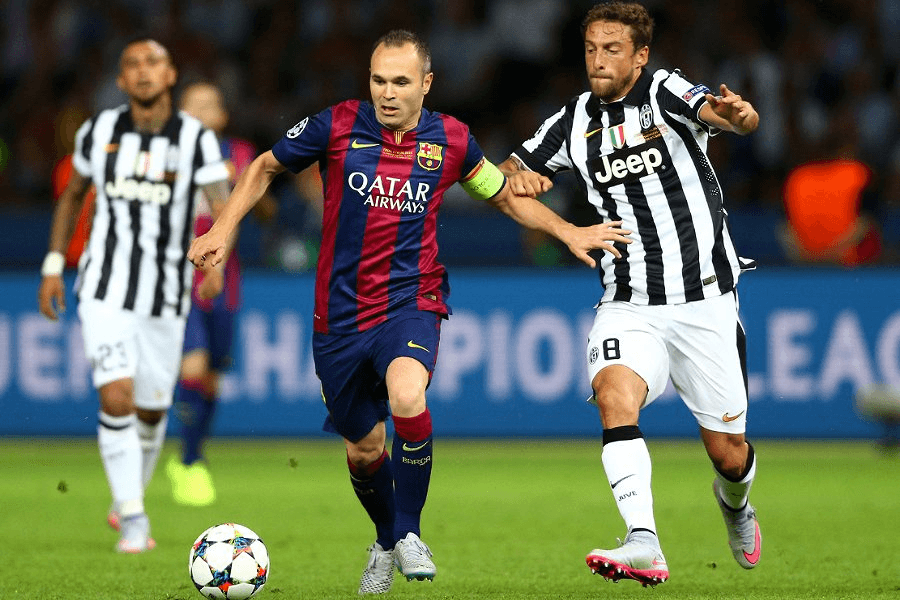
What the role demanded was individual flair rather than systematic execution. Defensive duties existed, but involvement in attack came first. Because positioning could change freely with the course of the match, players who combined off-the-ball movement, running power and the technique to break a situation open were prized.
Milan's Clarence Seedorf became the engine as a right-sided mezzala. Pavel Nedvěd, with a thunderous left foot and tireless running, drove through Juventus's midfield. Liverpool's Steven Gerrard, at his peak, burst out of midfield to score again and again and rescued his team many times.
And then there is Claudio Marchisio. Raised in Juventus's youth system, he was known affectionately as "Il Principino" (the little prince). One moment he is at the base of midfield; the next he has appeared in the opponent's penalty area. He served his team through movement in the time without the ball and showed up in decisive moments. His play embodied the essence of the mezzala. Unbound by a fixed pattern, he appeared in the optimal place for each situation. That freedom was the charm held in the word mezzala.
In attack he opens wide to receive and either cuts inside or delivers a cross. Without the ball he presses the opposition's full-backs or midfielders, though defence is not necessarily the priority. In Italy from the 1980s to the 2000s, reliance on individual ability was strong and it was a role that could move freely according to how a match unfolded.
The All-Round Gear of Attack and Defence: The Inside Half
The inside half is, in English, an "inside midfielder." It shares with the mezzala its place on either side of the midfield three, in front of the anchor or pivote. But what this position demands has changed greatly in modern football, where possession-based and high-pressing styles dominate.

In attack it receives between the opponent's lines and either connects to the forwards with one touch or penetrates itself. Without the ball it destroys the opponent's build-up with high pressing and pressing back, and fills the open space. Modern tactics revolve around "building numerical superiority" and "transitions"; the inside half must be an all-rounder who can react instantly to both.
Manchester City's Kevin De Bruyne is the symbol. Sharp passes from his right foot, the drive to carry the ball himself. Combining scoring and assists, he also faithfully followed the defensive agreements of Pep Guardiola's meticulous system. İlkay Gündoğan, with tactical flexibility, skill in keeping the ball and understanding of defending, performed several roles at a high level. From the playmaker-like role of his Dortmund days to the runs from the inside of midfield at City, several faces co-existed in one player. Bernardo Silva, with a small frame, kept hold of the ball and functioned as the lubricant of possession. Moving between right wing and the inside of midfield, he carried the ball to where teammates could receive it easily. He creates value not by deciding a match with one flashy blow but by making the whole team's movement smoother.
A Shift in Thinking About Space: The Half-Space
The concept of the "half-space" spread by Guardiola at Bayern also helped drive this change. It divides the pitch into five vertical lanes and uses the space between flank and centre. For opposing defenders it is unclear who should pick up a player standing in this space, and that is where the inside half stands. If the mezzala cut through space with individual flair, the inside half controls space by the logic of organisation.
The difference shows in how players are raised. A mezzala is founded on individual skill polished in free play at a local club. An inside half is asked from the youth stage to understand and carry out tactics, and to translate the coach's intention into action on the pitch in an instant. The changing way of teaching football is mirrored in the role of the flanks of midfield.
Different Countries, Different Flanks

| Aspect | Mezzala | Inside half |
|---|---|---|
| Main role | Attack-minded, runs and breaking lines | Both attack and defence, star of transitions |
| Valued abilities | Off-the-ball movement, running power, individual skill | Judgement, defensive understanding, tactical execution |
| Tactical background | Individual freedom, attacking bias | Organised pressing, tactical coordination |
| Representative era | 1980s to 2000s | 2010s onward |
Even for the same flank of midfield, the role asked of a player differs by country and culture. The depth of football lies there.
The difference reflects the football views each country has nurtured. Italy loved the moments when individual talent decides a match, on a foundation of defensive solidity. Spain held to the aesthetic of controlling matches by keeping the ball. Germany and England found the essence of competition in the speed and intensity of transitions. In how players on the flanks of midfield behave, a country's football values are concentrated.
In Italy the mezzala was described through attacking runs, individual flair, running power and tactical freedom. In Spain the "interior" became a symbol of possession football, building through short passing and delicate positioning. In Germany and England the inside half carried the intensity and speed of transitions, demanding physicality, vertical movement and instant judgement.
The mezzala was a craftsman who brought individual stories into tactics. The inside half is a conductor who melts the individual into tactics. Neither is better; they merely changed shape as the times required. What role will be born next? Tactics will again make new demands. On the flanks of midfield, the future of football will keep gathering. Each time the ball moves from centre to wing and wing to centre, the judgement of the player standing there changes the expression of the match. In the next game, follow the movement of the players on the flanks. In it you should see the tactical history they carry and the football of the country they grew up in.
Popular this week
7 DAYS
01選手物語
The Japanese Philosophy Quietly Anchoring Michael Olise’s Genius
02フットボール文化
The Dream Seven Men Chased in a Parisian Alley: How FIFA Became the "Universal Language of the Earth"
03フットボール文化
Fierce Rivals Under One Sacred Roof: The Secrets of San Siro and Milan’s Shared Cathedral
04legend
The Endangered Soul: Football's "One-Club Men" and the Lost Romance of Undying Loyalty
Share this story



CommentsComing soon
As someone who shares the story, we'd love to hear your words.